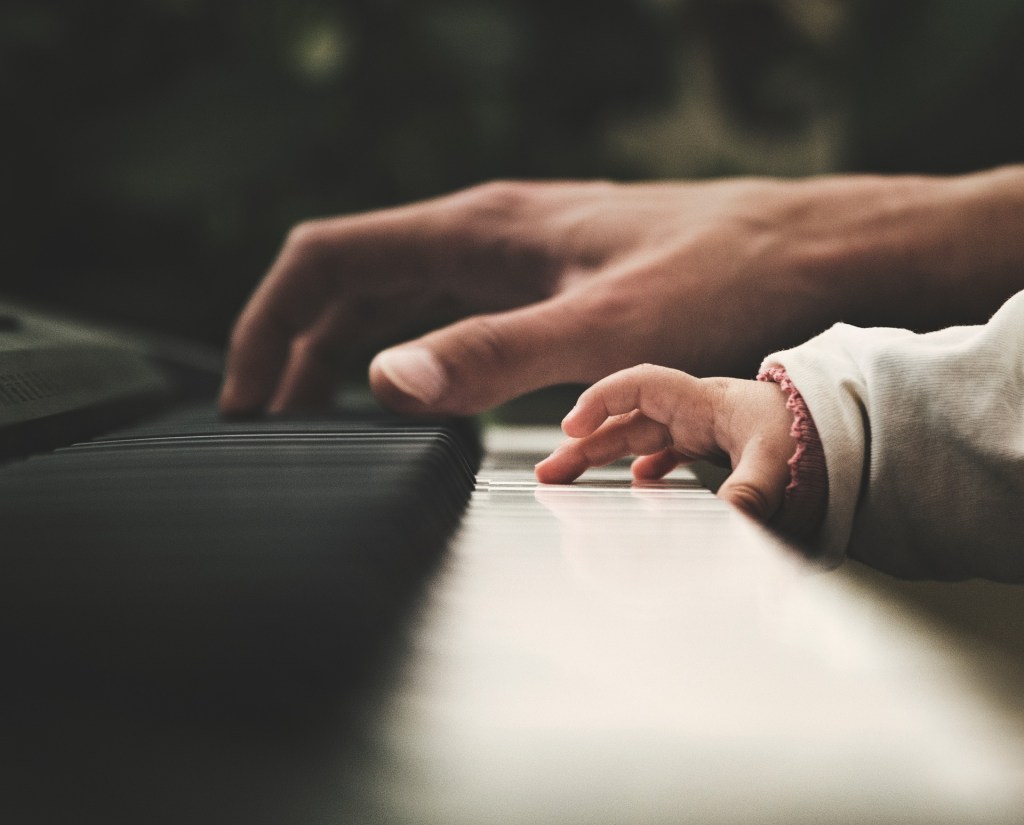
Learning by Listening
Watching the piano learning process is fascinating to me, and has led me to great reflection on my own learning experiences and the development of a bounty of questions. How soon to introduce certain music theories, how hard to hit reading music, how fast to start expecting certain performances… all part of shaping musical performance development. Part of the basic building blocks in learning to play piano is learning scales – sounds exciting, right?! And for very young students, those scales are only the first five notes of the C scale, while learning the musical alphabet (A B C D E F G, for anyone learning to read music!), which means C D E F G are played. This is simply because they have 5 fingers, it’s easiest to focus on the first 5 of the 8 notes that comprise a full octave scale.
The thing about laying a foundation is that it’s hard work, and can become tedious; it’s a challenge to the teacher as well to help keep this from becoming a chore. I favor methods that allow a student to listen to the music, to hear the song first, then use their own senses to mimic the playing, search the keys for familiar ground, and discover their ability to match tone, rhythm, dynamics. It is much faster and quite more rewarding to the student to learn a piece of music this way, than drudging through the whole process of reading music, deciphering what it means on the page, translating for themselves what keys they should play, and then how exactly to play them. Learning to read music is important, but mastering it is not that different than learning more English vocabulary, or taking on learning Spanish, Mandarin, or Russian languages. Time, patience, and the right amount of critical thinking to learn the rules are necessary, but allowing students to discover the joy of playing and making their own music can happen faster than learning exactly how to read sheet music. Some of the best musicians I know have never learned to read sheet music, or delayed that process greatly as they explored their own music-making abilities first.
As musical ability matures, students will stretch beyond the first 5 notes; in order to reach 8 notes of an octave fluidly, the pianist much know when to pull the thumb under or stretch the third finger over to continue seamlessly on the merry way. And onward those building blocks are stacked, until the scales and arpeggios learned lend themselves to a faster study of the compositions of Beethoven, Mozart, Schmidt, or even that favorite Disney song. Children as young as 3 years old can begin plunking out different tunes and learning to string together notes, while other children will be better able to focus and learn by the time they’re 6 years old. From then, it requires the desire and the discipline to work at the piano daily, building habits that make regular practice a natural part of a daily routine. Spanish child prodigy Michael Andreas Haeringer began playing when he was 5, and was so enthralled with playing would practice upwards of 3 to 5 hours per day. He began performing at 8 in professional concert halls, and now at 18 years old is considered a true virtuoso. He is certainly an enigma, but who knows how your own musical journey will start and where it will take you! (Check out his performance in 2008 at 8 years old, and his channel has many other more recent uploads that are fun to watch! Thanks to my friend and former piano mentor Mary Moses for sharing.)
But honestly, it doesn’t matter what age you are. There is a universal language found in music, and a beautiful way to connect with other humans to understand more about ourselves and each other.
 South Funk Studio